
Non-Clinical Jobs for Speech-Language Pathologists (SLP)
Explore non-clinical SLP career paths across healthcare ops, tech/sales, and education, with pay ranges and how your license and skills transfer.
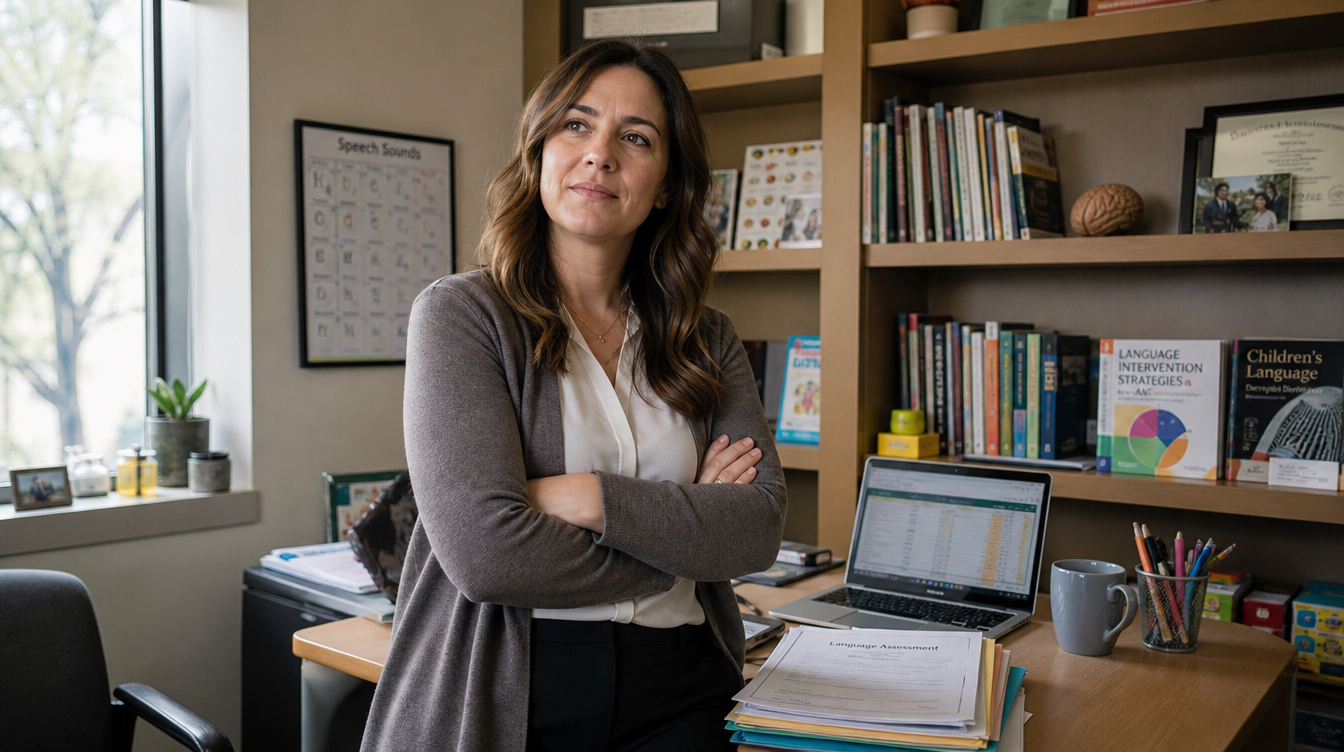
If you have ever read a "non-clinical healthcare roles" list and found it written entirely for nurses, you are not imagining it. Speech-language pathologists rarely get their own list, which means Speech-Language Pathologists (SLPs) have been asked to reverse-engineer career guidance built for someone else's license. This one is yours.
Non-clinical jobs for SLPs fit into three main groups: healthcare operations, tech/sales/communications, and coaching/education. Each group uses skills you already have, and each pays differently. The US Bureau of Labor Statistics reports that the median annual pay for SLPs was $97,870 in May 2025, and the field is expected to grow 17 percent from 2025 to 2035. Keep that number in mind as a starting point, not a limit.
Key Takeaways
- Non-clinical SLP roles fall into three buckets: healthcare operations, tech/sales/communications, and coaching/education.
- Pay ranges from roughly $47,000 to $100,000+, depending on bucket and seniority.
- Some roles use your license directly. Others treat it as a credibility issue rather than a requirement.
- Your ASHA certification can stay active without a clinical caseload.
Why SLPs Are Well-Positioned for Non-Clinical Roles
SLPs' knowledge and training are unusually transferable. You spend your days doing something most corporate teams pay consultants to teach: explaining complex information to someone who is not an expert, then checking if it worked.
Think about what happens in a single treatment session. You check a person's starting point, create a plan with clear goals, change it as they respond, write down your clinical reasoning in language a payer will accept, and work with doctors, nurses, teachers, occupational therapists, and families, each needing the same information explained differently. This is managing different people, designing instructions, collecting data, and writing reports, all at the same time and under time pressure.
Then there is the specialty knowledge itself. You know how speech, language, thinking, and swallowing work, and how they can go wrong. This is not common knowledge. It is exactly the expertise a speech-recognition team, an AAC company, a dysphagia product line, or a patient-education group needs, and rarely finds.
Clinical work builds this. The question is not whether the skills are valuable outside the treatment room. It is which non-clinical healthcare roles are built to use them.
Non-Clinical SLP Roles by Category
The three groups below are listed by how close they are to your current work. Pay numbers are U.S. national averages or medians and will vary by location, workplace, and experience.
Healthcare Operations
These jobs ensure patients move through the system properly: the right admission, the right level of care, and the right paperwork to support both. Your skill with medical-necessity language is a plus because you have spent years writing justifications that had to pass a payer's review. Healthcare operations is usually the quickest group for SLPs to enter since hiring managers already know your credentials.
Tech, Sales & Communications
This is where SLP expertise is most valuable because speech and language products cannot be made well without someone who understands how communication really breaks down. Companies making AAC devices, speech-recognition tools, dysphagia products, teletherapy platforms, and patient-education materials all need that expertise during design, not after launch. Medical sales is different: it is easier to sell therapy equipment when you have used it on a real patient.
Coaching & Education
This bucket sits closest to what you already do, and it is where many SLPs often start their work. Accent coaching and executive communication coaching are often paid by clients directly and self-managed, so salary averages matter less than your rates and how many clients you have, and many SLPs do this alongside other jobs instead of full-time. Clinical education and corporate training, on the other hand, are regular salaried jobs in health systems, universities, and device makers.
Does the Role Use Your License, or Do You Start Over?
The honest answer: it depends on the bucket, and this difference matters more than most career advice content admits.
Healthcare operations: often yes. Clinical liaison roles in rehabilitation and post-acute settings are frequently written for "SLP, PT or OT," and your license is the qualification. Utilization review and case management are less consistent. A meaningful share of those postings specify RN or LCSW, because payer contracts and state regulations were written around nursing and social work. You are not starting over, you are competing for the subset of roles that name your credential, which means targeting matters more than volume.
Tech, sales, and communications: no, and that is the point. Nobody in an edtech product review will ask for your CCC number. What they are buying is domain expertise, and the license is the proof it is real. For technical and scientific sales specifically, the Bureau of Labor Statistics notes employers typically need at least a bachelor's degree, your master's clears that bar comfortably.
You are not starting over here either; you are starting sideways, entering as the person in the room who actually understands the clinical problem.
Coaching and education: yes, in different ways. Clinical educator roles typically want active licensure. Accent coaching is more nuanced: ASHA states that SLPs provide accent modification as an elective clinical service, and that accents (regional, foreign, or nonnative) are not a communication disorder. It is within your scope, but the field is open to non-SLPs too, so your license is a differentiator rather than a gate.
A practical note: "uses your license" and "requires your license" are different questions. Many roles that do not require the CCC-SLP still prefer to hire SLPs, because the alternative candidate cannot read a swallow study.
And the underlying question: keeping your ASHA certification does not require a clinical caseload. Certificate holders complete 30 professional development hours per three-year interval, including at least one hour of ethics and two hours in cultural competence/DEI. You can hold the CCC-SLP indefinitely while working in a non-clinical role.
How to Translate Speech-Language Pathologist Skills Into a Corporate Resume

The reason a strong SLP resume stalls in corporate applicant tracking systems is not the experience. It is the vocabulary. Clinical resumes are written for licensing boards and clinical directors; corporate resumes are written for hiring managers scanning for business outcomes. Same work, different language.
This is the single highest-leverage piece of the transition, and it is also the one most SLPs underestimate. You are not inventing new experience. You are re-labeling experience you already have so that a recruiter outside healthcare can recognize its value in six seconds.
Three moves do most of the work:
Replace clinical nouns with business terms. "Managed a caseload of 45 patients" becomes "managed a portfolio of 45 concurrent cases with individualized plans and measurable outcome targets." "Wrote treatment plans" becomes "authored documentation supporting reimbursement decisions."
Lead with the outcome, not the activity. Corporate readers want the result first. Discharge rates, goal attainment percentages, productivity against benchmark, denial-rate improvements after a documentation change, metrics you already generate.
Name the cross-functional work explicitly. Interdisciplinary team meetings are stakeholder alignment. Family training is end-user education. Supervising a clinical fellow is people management and onboarding design.
MatchDay's full walkthrough of this process covers each of these moves in more depth, and if remote work is part of what you are after, start with the complete guide to remote healthcare careers.
Translate, do not inflate. Corporate hiring managers can tell the difference between a clinician who has reframed real work and one whose resume is padded with borrowed vocabulary, and the second one falls apart in the interview.
Download the resource, then bring it to a session. Translation gets faster with someone who has done it before reading over your shoulder, and a personalized roadmap will tell you which bucket to aim the resume at first.
Take the Leap Into a Non-Clinical SLP Career
SLPs have not had a role list built around their license until now, and the honest version is more encouraging than the generic one: three distinct buckets, real pay ranges, and a credential that stays active whether or not you carry a caseload.
What that list cannot tell you is which bucket fits you: your setting, your specialty, your geography, your timeline. That is the work a personalized roadmap does.
MatchDay's Fellowship pairs you with vetted coaches with 2,500+ hours of experience for 1:1 coaching, white-glove service through the transition, and access to a network of fellows who have already navigated it. That is the MatchDay Promise: our fellows open doors for new fellows.
Not sure which bucket fits your background yet? Start with the Free Career Assessment before deciding on anything bigger.
If you are ready for transformation, the next step is a conversation.
See If You Qualify
Frequently Asked Questions
Do I have to give up my SLP license to work non-clinically? No. Certification maintenance runs on a three-year interval, requiring 30 professional development hours, including one hour of ethics and two hours in cultural competence/DEI, with no clinical caseload requirement. Most fellows keep the license active while they transition.
Are non-clinical SLP roles available remotely? Many are. Utilization review, content strategy, and UX research are commonly remote; clinical liaison and medical sales are usually field-based by design.
Does the CCC-SLP still matter outside the clinic? It matters. In healthcare operations and clinical education, it is often a stated requirement. In tech and sales, it adds to your credibility and experience, proof that your clinical knowledge is verified rather than self-taught.
Which roles are easiest to enter? Generally, the ones that name your license in the posting are clinical liaison and clinical educator. Tech and sales roles take longer because you are also learning the vocabulary of a new industry.
How does the pay compare to clinical SLP work? It depends on your setting. Against the SLP median of $97,870, school-based SLPs (median $80,280 in educational services) often see an increase, while SLPs in nursing and residential care facilities (median $106,500) may move laterally at first.
See If You Qualify

.avif)